
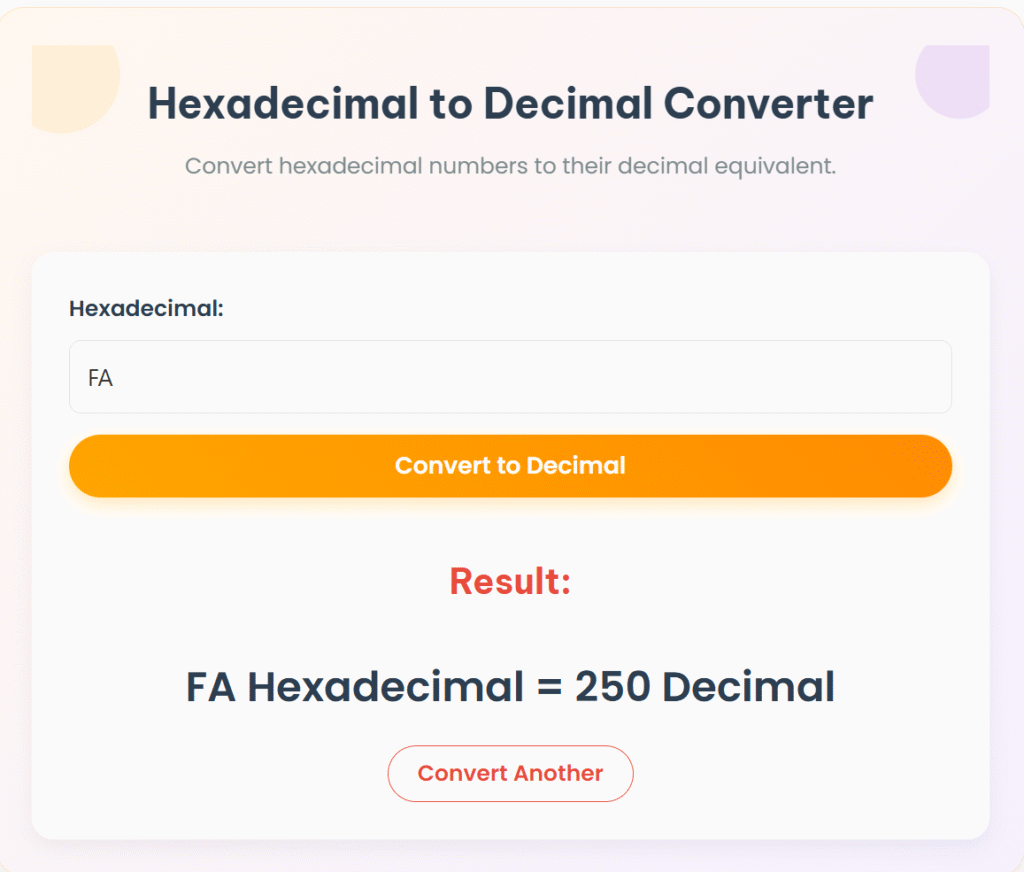
Hexadecimal to Decimal Converter
Convert hexadecimal numbers to their decimal equivalent.
Result:
Hexadecimal to Decimal Converter: Free Online Tool & Step-by-Step Guide
Hexadecimal (base-16) is a widely used number system in programming, digital systems, and low-level computing. Understanding how to convert hexadecimal to decimal is essential for tasks like debugging code, interpreting memory addresses, and working with digital color codes.
Our free Hex to Decimal Converter provides instant, accurate results with clear, detailed explanations. This comprehensive guide will cover:
- How to easily use our online converter tool
- Two simple manual conversion methods (e.g., positional multiplication)
- Practical applications of hexadecimal to decimal conversion in computing
- Common conversion examples and a quick reference table
- Answers to frequently asked questions (FAQs) about hex conversion
How to Use Our Hexadecimal to Decimal Converter Online
Our hexadecimal to decimal conversion tool is fast, accurate, and works seamlessly on any device. Follow these simple steps for quick and precise conversions:
- Enter Your Hexadecimal Value: Input any hexadecimal number (e.g.,
1A3,FF,C0FFEE) into the designated field. Our tool efficiently supports all hex digits (0-9, A-F) and handles both uppercase and lowercase letters. - Click “Convert”: The tool processes your input instantly, displaying the decimal equivalent.
- View the Decimal Result Instantly: Get your precise decimal output, accompanied by a clear, step-by-step explanation of how the conversion was performed.
Example Conversion:
- Hexadecimal Input:
1A3 - Decimal Output:
419
Why Use Our Free Hex to Decimal Tool?
- No software download required: Access our online hexadecimal to decimal converter directly from your web browser. No installations, no hassle.
- Supports all hex digits (0-9, A-F): Ensures accurate conversions for any valid hexadecimal input.
- Handles both uppercase and lowercase letters: Provides flexibility and ease of use, accepting inputs like
1a3or1A3. - Provides step-by-step explanation: Our tool doesn’t just give the answer; it helps you understand the logic behind every hex to decimal conversion, making it an excellent learning aid.
- No installation required: Use it directly online without any setup.
Popular Number base Converters
- Convert Binary to Decimal
- Convert Decimal to Binary
- Convert Decimal to Hexadecimal
- Convert Binary to Hexadecimal
- Convert Hexadecimal to Binary
Hexadecimal to Decimal Conversion: Manual Methods Explained
For those looking to understand the underlying mathematics of how to convert hexadecimal to decimal, here are two common manual conversion techniques used in various technical fields.
Method 1: Positional Multiplication (The Standard Approach)
This is the standard mathematical approach and the most common method for hexadecimal to decimal conversion. It leverages the concept of positional notation, where each digit’s value depends on its position.
- Assign positional values: Starting from the rightmost digit (position 0), assign increasing powers of 16 to each hexadecimal digit (160,161,162, etc.).
- Multiply each digit: Convert each hexadecimal digit to its decimal equivalent (A=10, B=11, etc.), then multiply it by its corresponding power of 16.
- Sum all the results: Add all the products together to get the final decimal value.
Example: Convert 1A3 (Hexadecimal) to Decimal
| Hex Digit | Decimal Value | Position (n) | Calculation | Value (Decimal) |
|---|---|---|---|---|
| 3 | 3 | 0 | 3×160 | 3 |
| A | 10 | 1 | 10×161 | 160 |
| 1 | 1 | 2 | 1×162 | 256 |
Export to Sheets
✅ Total: 256+160+3=419
Method 2: Binary Intermediate (An Alternative Method)
This alternative method is particularly useful if you are already comfortable with hexadecimal-to-binary and binary-to-decimal conversions. It leverages the direct relationship between hexadecimal and binary (one hexadecimal digit represents exactly four binary digits).
- Convert each hex digit to 4-bit binary: Convert each individual hexadecimal digit into its 4-bit binary equivalent.
- Combine all binary digits: Concatenate all the resulting 4-bit binary strings to form a single long binary number.
- Convert the combined binary number to decimal: Use the standard positional notation method to convert this large binary number into its decimal equivalent.
Example: Convert 1A3 (Hexadecimal) to Decimal via Binary
1(hex) →0001(binary)A(hex) →1010(binary)3(hex) →0011(binary)- Combined binary:
000110100011 - Convert binary
000110100011to Decimal:- 1×28+1×26+1×23+1×22+1×20
- 256+64+8+4+1=419
✅ Answer: 1A3 (Hexadecimal) = 419 (Decimal)
Practical Applications of Hexadecimal to Decimal Conversion
Understanding how to convert hexadecimal to decimal is crucial across various technical domains:
- Computer Programming: Essential for memory address interpretation (e.g., when debugging
0xvalues in C/C++ pointers) and for understanding hexadecimal dumps of program memory. It’s also vital when working with register values in embedded systems programming. - Web Development: Key for color code conversion (e.g., converting
#FFFFFFhex values back to their RGB decimal components for design tools or understanding specific shades). Also used in interpreting character encoding (like Unicode values) often expressed in hex. - Digital Electronics: Fundamental for microcontroller programming, FPGA (Field-Programmable Gate Array) configuration, and direct hardware register manipulation, where values are often documented and set in hexadecimal.
- Data Analysis & Security: Used in binary file analysis (e.g., reverse engineering), network packet inspection (where packet data is often displayed in hex), and understanding various hexadecimal encoding schemes used in data communication and security.
Hexadecimal to Decimal Conversion Table (Quick Reference)
This table provides a quick reference for common hexadecimal to decimal conversions for your convenience.
| Hexadecimal | Decimal |
|---|---|
| 0 | 0 |
| A | 10 |
| F | 15 |
| 10 | 16 |
| FF | 255 |
| 100 | 256 |
| FFF | 4095 |
| 1000 | 4096 |
Export to Sheets
Frequently Asked Questions (FAQ) about Hexadecimal to Decimal Conversion
Q1: How do I handle lowercase hexadecimal letters (a-f) in conversion?
Lowercase hexadecimal letters (a, b, c, d, e, f) represent the exact same decimal values as their uppercase counterparts.
a= 10,b= 11,c= 12,d= 13,e= 14,f= 15. Our converter tool handles both uppercase and lowercase inputs seamlessly.
Q2: What’s the largest 32-bit hexadecimal value?
The largest 32-bit hexadecimal value is FFFFFFFF. In decimal, this is equivalent to 4,294,967,295. This often represents the maximum value for a 32-bit unsigned integer in computer systems.
Q3: Why is hexadecimal used instead of binary?
Hexadecimal is preferred over binary in many contexts because it’s more compact and easier to read and write. One hexadecimal digit represents exactly four binary digits (a “nibble”). This significantly shortens long binary strings, making them less prone to transcription errors and more manageable for human interpretation, especially in programming and memory analysis.
Q4: How do I convert hexadecimal fractions to decimal?
To convert hexadecimal fractions (e.g., 0.A) to decimal, you treat the fractional part as negative powers of 16, similar to how decimal fractions use negative powers of 10.
- Example:
0.A(hex) = 10×16−1=10×(1/16)=10/16=0.625 (decimal). (Outbound Link Suggestion: Link to a detailed guide on “converting hexadecimal fractions to decimal” from a math or CS educational site.)
Q5: What does the ‘0x’ prefix mean in hexadecimal?
The 0x prefix is a common notation in many programming languages (like C, C++, Java, Python, JavaScript) used to explicitly indicate that the following number is in hexadecimal notation. For instance, 0xFF clearly means the hexadecimal value FF, distinguishing it from the decimal value 255. This helps prevent ambiguity when numbers are displayed.
Conclusion
Mastering hexadecimal to decimal conversion is a crucial skill for anyone working with low-level programming, digital systems, or web development. Our free online tool makes these conversions instant and effortless, while understanding the manual methods provides a deep, invaluable comprehension of foundational computing principles.
🚀 Ready to simplify your work? Try our Hexadecimal to Decimal Converter now and enhance your understanding of number systems!